


Artificial Intelligence in the Code of Criminal Procedure
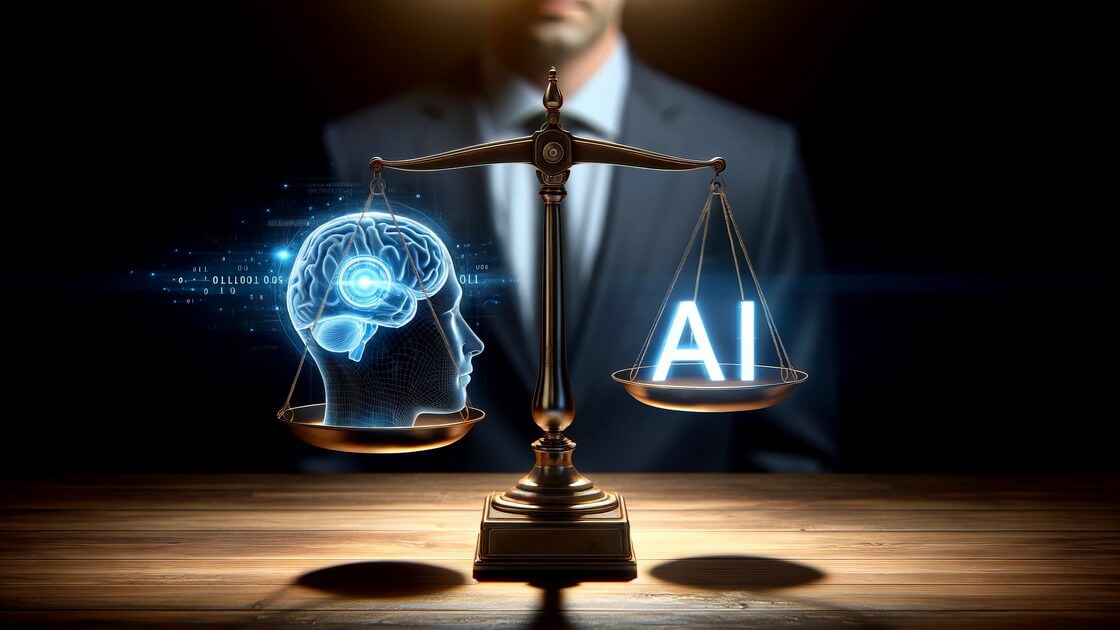
To date, under the legislation currently in force in Egypt, there is no general provision stating that all Artificial Intelligence outputs constitute independent judicial evidence. Nevertheless, the court may rely on Artificial Intelligence outputs or analyses as a presumption or as part of digital evidence, provided that it is possible to verify their source, integrity, and the possibility of discussing them before the court.
What is meant by the use of Artificial Intelligence as evidence in criminal cases?
The use of Artificial Intelligence as evidence in criminal cases does not mean that Artificial Intelligence testifies before the court. Rather, technologies based on Artificial Intelligence are used to extract, analyze, or support evidence.
Why has Artificial Intelligence entered the courtroom? Practical and legal reasons
Practical reasons:
- The tremendous technological development and the spread of cyber and digital crimes that are difficult to detect by traditional means.
- Speed of data processing: Artificial Intelligence can analyze thousands of files, messages, and recordings within a short period of time.
- Enhancing the efficiency of investigations through facial recognition and the analysis of digital evidence.
- Reducing human effort in reviewing the enormous volume of documents and data.
- Increasing the accuracy of certain technical processes, such as detecting digital forgery and analyzing criminal patterns.
Legal reasons:
- The development of means of proof; the law does not remain static in the face of technological development, but rather adapts to it.
- The increasing recognition of digital evidence in modern legislation, which has opened the way for the use of Artificial Intelligence tools in examining such evidence.
- Achieving expeditious justice by accelerating litigation and investigation procedures.
- The increasing volume of digital evidence that human beings cannot analyze manually.
- The desire to reduce human errors in investigations (false confessions – erroneous procedures).
- The need to predict crimes before they occur (predictive policing).
Does this mean abandoning the human judge? No, rather it supports the human judge.
Types of Artificial Intelligence evidence that have begun to appear in criminal cases
- Analysis of surveillance camera footage through automatic facial recognition.
- Analysis of text and voice conversations using large language models.
- Predicting the dangerousness of the accused or the likelihood of reoffending through risk assessment systems.
- Analysis of mobile phone locations and GPS data using algorithms.
Example: A stock manipulation case in which AI detected a suspicious pattern that investigators had not noticed.
The current legal framework in Egypt for the admissibility of Artificial Intelligence evidence
To date, there is no independent and comprehensive Egyptian law on Artificial Intelligence that is fully effective and binding. However, there is a national strategy, a governance framework, and official guidelines that increasingly regulate its use.
Are Artificial Intelligence outputs considered expert evidence, physical evidence, or something else?
Artificial Intelligence outputs are generally not considered physical evidence in themselves; rather, they are closer to a means of expert evidence or a technical opinion. Physical evidence is something that directly proves the fact, such as: a fingerprint, the weapon used in the crime, a camera recording, or an original document.
Expert evidence is a specialized opinion that assists the court in understanding or analyzing the evidence, such as: a forensic medical report or the report of a digital forensic expert.
The position of the Egyptian Court of Cassation on digital and technological evidence to date
Recognition of the evidentiary value of electronic evidence whenever it satisfies the legal and technical requirements prescribed in the legislation regulating electronic transactions and electronic signatures. Accordingly, there is no preliminary rejection of digital evidence merely because it is electronic.
A major legal gap:
There is no clear provision permitting or prohibiting the use of AI as evidence. Advanced Artificial Intelligence-based solutions for reducing crimes before they occur.
Predictive policing:
Algorithms that identify the areas and persons most likely to commit a crime or become victims of crime.
Analysis of social media to detect early threats (violence – terrorism – blackmail).
Early warning systems in banks and financial institutions to prevent fraud.
Does this affect personal liberty?
Yes, if it is not regulated by law.
Balancing the benefits of Artificial Intelligence as evidence and the protection of personal liberty
The principle of legality in criminal law: No crime and no punishment except by virtue of a legal provision. Does it apply to evidence? An act may not be considered a crime unless there is a legal provision criminalizing it, and no punishment may be imposed unless there is a legal provision prescribing it.
The principle of the inviolability of private life (Article 57 of the Egyptian Constitution): The principle of the inviolability of private life is one of the fundamental constitutional principles and means that every person has a sphere of his life into which neither the State nor individuals may interfere or gain access except in the cases permitted by law.
When does the use of Artificial Intelligence become a violation of the right to a fair trial?
The use of Artificial Intelligence becomes a violation of the right to a fair trial when it affects the fundamental guarantees of the accused or the parties, such as the right of defence, the right to confront the evidence, the right to equality between the parties, and the right to appear before an independent and impartial judge.
Three essential conditions for the fair admissibility of Artificial Intelligence evidence
- First condition: Transparency of the algorithm; that we know how the Artificial Intelligence reached its conclusion.
- Second condition: The possibility of challenging the evidence by the parties.
- Third condition: Human intervention by a judge or an expert to review the result before its admission.
Major legal challenges when using Artificial Intelligence in criminal proceedings
- The black box problem (the algorithm does not explain itself).
- The possibility of algorithmic bias against certain groups (race – gender – geographical area).
- The difficulty of challenging Artificial Intelligence evidence by a lawyer who is not specialized in technology.
- The absence of Egyptian legislation regulating the process of verifying the validity of Artificial Intelligence outputs.
When may Artificial Intelligence evidence be appealed before the Egyptian courts?
Before the Egyptian courts, evidence derived from Artificial Intelligence may be appealed on several legal grounds, even though there is still no specific legal provision comprehensively regulating this type of evidence.
- Appeal against the legality of obtaining the data.
- Appeal against the integrity of the technical system.
- Appeal against the source of the data.
- Appeal on the grounds of lack of transparency and explainability.
- Appeal on the grounds of bias or discrimination.
- Requesting the appointment of a technical expert:
- If the underlying data was obtained by unlawful means (without a judicial authorization).
- If the algorithm is undisclosed or owned by a third party and cannot be tested.
- If it is established that the system was trained on biased or inaccurate data.
- If the evidence represents an opinion rather than an established fact (such as predictions).
How may evidence generated by Artificial Intelligence be appealed before the Egyptian courts?
Evidence generated by Artificial Intelligence may be appealed before the Egyptian courts through the following:
First: Pleading the nullity of the evidence.
Second: Disputing the technical evidentiary value of the evidence.
Third: Requesting the appointment of an expert.
Fourth: Invoking a violation of the right of defence.
Fifth: Appealing the chain of integrity of the digital evidence.
What are the conditions for the admissibility of Artificial Intelligence as evidence under the Egyptian Code of Criminal Procedure?
- The lawful obtaining of the data.
- The integrity of the digital evidence.
- The reliability of the system used.
- Verifiability and reviewability.
- Respect for the right of defence.
- Consistency with the presumption of innocence.
- The court’s conviction.
In which types of crimes may Artificial Intelligence currently be used as evidence?
(Information Technology crimes – Electronic forgery crimes – Fraud and deceit crimes – Terrorism crimes and organized crimes).
May an Egyptian judge rely solely on Artificial Intelligence analysis to convict the accused?
No. From both the legal and practical perspectives, an Egyptian judge should not rely solely on Artificial Intelligence analysis as the sole evidence for convicting the accused.
The reason for this is based on several considerations:
- The principle of judicial conviction under Egyptian law requires the judge to base his conviction on the evidence presented in the case.
- The right of defence requires that the accused and his lawyer be able to discuss the evidence and appeal it.
- Artificial Intelligence is an assisting tool, not a witness or an independent expert.
How does Egyptian law protect personal liberty when using Artificial Intelligence in investigations?
Egyptian law protects personal liberty when using Artificial Intelligence technologies in criminal investigations through a set of constitutional and legal safeguards, even though there is still no specific Egyptian law regulating Artificial Intelligence in the criminal field in detail.